Showing posts with label culture. Show all posts

Saturday, February 11, 2012

Building homes for Christ; under construction & constructed

I've already described Lisa, one of my first friends here.  She's working to build homes for families of up to 5 orphans to be adopted by Mozambique parents.  She took me out to the property that's currently under construction.  News on Friday was that 3 children are already set to move in with willing parents from an orphanage formerly run by Iris Ministries.


The property where the current house is being built got quite a bit of water with recent showers - so we had some sloughing to do through the mud and shin deep pond water to get to the house.  One of the things I love about how Lisa is doing what she's doing, is that she's hiring and training vocational students to do the labor on the house.  It's more work for her to help train them, but it's cost effective and gives them an opportunity to get work experience.  One of the workers asked Lisa to take a picture of him in his work gear because he was so proud and wanted to post it on facebook. :)
Proud worker!


On Saturday, I had my first Mozambican family meal with the family that is already living in the first house that she's constructed.  The couple has adopted 4 orphans, then had one child and is now expecting another.  We sat for a long time outside in front of the house as the oldest daughters washed and prepared the food.  The mother was trained to sew and so an old pushpeddle sewing machine sat next to us as chickens, children, and the beloved dog ran around.  It was a humble home - not out of the ordinary for Mozambique, so it was cool to see the kids thriving in a typical home environment.


Dinner began with prayer, the children each got served (special night with meat!).  Normally, dinner is eaten with hands and rarely not at a table.  If there is a table, I'm told, the husband sits at it and the wife and children sit on straw mats on the floor.  So our meal wasn't completely typical because our dinner was eaten at a table.

After dinner the children were all asked by Lisa if they had anything they needed or had questions about.  She acts kind of like a social worker in checking in on them, and there was nothing new from any of them.  Then the whole table took turns in praying out loud.

We got led home in the dark with a flashlight on the narrow path by the three oldest children.  On giving Lisa a final hug, the oldest daughter said, "I really enjoyed going to the beach with you that time.  Do you think you could find time to go again?"
Someone forgot to take a pic at dinner!
Too sweet.

Sunday, February 5, 2012

Zimbabwe (Trip #2): Culture

LANGUAGE

Most commonly spoken languages: English, Shona
Important phrases to learn:
Majeeta (with hand clapping, or cupping for women) = thank you
Uri bo? = how are you?) Didi bo? = I'm good)
Roonina = delicious
a-Eh = yes

I realized shortly into the drive to Zim, that I was repeating myself frequently in mistaking Helen's a-eh (yes) for an eh? (i don't understand.) When it became evident she said eh to everything, I quickly stopped echoing myself. :P Ah, the joys of foreign languages.

POLITICS

"illegal" photo at the post office
It is absolutely fascinating to hear Zimbabweans takes on Mugabe. To summarize, it appears that most of the country has taken the view of, "Mugabe can't live forever. We will outlive him and then choose our leaders." They're peaceable and patient. It's apparent though too, they know if you say something against the government, 'well, just be prepared to disappear the next day.' To note, I got in trouble at the post office for snapping a picture (no it's not like anyone's face/identity was captured). I immediately was asked if I was a reporter. When I said no, one of the disgruntled bystanders said "It's illegal to take pictures here without permission." I of course apologized but walked away scratching my head at the immediate suspicion and fear that surfaced with a photograph.


FOOD

The food was delicious. I particularly liked sadzah (like a molded grits) and matikiti (steamed green veggies with spices) and peri-peri (chili peppers). We had more than one evening with lost power and candlelight suppers. Helen, because she had travelled in the US, knew we liked eggs for breakfast so a couple morning I made scrambled eggs for all of us.


Helen's family is similar to many in Mutare in having an adjacent machamba (garden/farm).  We went and picked fresh mangoes and had corn.  Sadly the avocado tree was still two months out from being ripe.

Vendors downtown.  Awesome produce!


EDUCATION

Boys at primary school

From the sounds of it, education is more valued than in Mozambique.  Particularly in Mutare where Methodist Missionaries came in the late 1890's brought a church and school.  The school has since grown from just a former primary and secondary school to a university called Africa University.  Just a quick history lesson, but Zimbabwe formerly was part of Rhodesia, called so because of the influence of Cecil B Rhodes.  You might know his name best for the Rhodes Scholarship

Girls at primary school


OTHER

Witchcraft and spirits still play a large part in cultural understanding and interpretation.  This was the front page for the local paper and was a story about a boy being possessed the spirit of a monkey that was killed at the same instant.  The boy's Shona description was something like "I was just taking a walk eating some leaves on my way to visit relatives when you killed me.  Why did you kill me?  You must make ammends!"  The boy went on to point out the accused monkey killers.  Obviously, said Helen, that's not real.  The boy's crazy.  But everyone reads it.


Many women wear weaves here.  So it was actually pretty interesting to watch how that's done too!

Zimbabwe (Trip #2): People

Driving to Zimbabwe:Helen and Dan
Helen is a teacher at the Beira International School here, but is from Mutare, Zimbabwe and goes back monthly to visit her children that still live there.  She offered to give us a ride to Zim, and once we got there, invited us to stay with her!!  Staying with a Zimbabwean family like Helen and her kids was such a huge blessing.

The main people we hung out with were: her son Rumbe (25 yo), other son Trip(21), her daughter, and a 5 year old neighbor named Shamayne, who particularly loved visiting us to be tickled and to dance.


Shamayne, as a little diva
Shamayne just asking to be tickled.
Vumba look-out with Trip and Rumbe
Tony's served REAL coffee and we gathered pears from the orchard
The living room of Helen's home was full of photos of the children from their school pictures and the graduation shots of when Helen graduated from college. I was curious about the family dynamics as there were pictures of the kids' father and it was obvious that Helen had been an influential single mother for a long time. On the trip home I asked about her husband as he had been brought up a few times by people we met in reference to how Rumbe was a good man like his father had been. He had died from a car accident when the youngest child was 2 years old. She had adopted the son Trip after her sister and brother-in-law died when he was 11 years old. Now Helen works in Mozambique because she is paid more and can support her children as they go to college. What a woman! She lives so far away from her children, but still supports them with monthly visits.

Trip, Dan, me, Helen, Rumbe, daughter, and maid Maria
My favorite memory of the trip was when Helen took us to her oldest half-brother's home to visit their family. Her brother is an apostolic pastor and farmer working for the ministry of agriculture. I asked her to tell me all their names and she stopped me and said, "before that we must pray!" Upon which Rumbe started singing a beautiful song that the rest of the family joined him in singing. At the end of their musical melodies we were motioned to kneel and then all the family members began praying outloud at the same time. I later asked Helen what they were singing in Shona. She said it was a greeting and story of how once they didnºt know God, but now they did in being born again and couldnºt stop giving him praises. It was one of those moments where even without translation you understand God's Spirit being present.

Saturday, January 28, 2012

Beira city highlights

Beira is a large city and is widely spread out.  The best way to get around is by chapas - but I hadn't really explored much until today.

Club Nautico, which has recently been redone and has a nice overlook of the ocean, is expensive.  They have good pizza and a private pool (which costs 375 mets ~ $14/day).  I was deterred by the cost to go swimming - also there was too much else to do today. (!) 
Club Nautico

Have you noticed a lot of beaches?  It's kind of the neatest geographical element of Mozambique - such a long beautiful coast.


If you look close enough there are lots of canoes in the water with fishermen


 First stop on way into explore is to grab an 'African pineapple'!  Which is basically a peeled pineapple you eat like a carmelled apple.

'African pineapple' DELICIOUS!

Praca de Municipio "Coke bottle plaza"

Family getting photographs for youngest's 3rd bday

 I wandered the city with Dan, a 3rd year family medicine resident from Alaska, who is here for 3 weeks doing a rotation at the same clinic.  He is living with Peter (my preceptor) and Peter's wife Emily.  He and Emily had already been down to this same area before and so he showed me around today.

While enjoying a cafe - we saw multiple wedding parties coming to take pictures at the Praca

Chapa ride

Praca de Municipio

Dinner at the Millards!

Sometimes when it's hot, we wear swimming suits to dinner :P

Bananagrams


We also went to Praia Nova Market but didn't buy anything.  On the chapa ride back we randomly ran into the Millards who invited me over for Peter's special pizza.


Wednesday, January 25, 2012

When helping helps


Just a prescript - internet and electricity are still intermittent so please be patient with correspondence!!!

Perspectives #3: Halfway through the wonderful read “When Helping Hurts.” I not only agree that it is a book that all Christians should read before they go into missions, but I would even argue it’s a good book for already well-seasoned missionaries.
Most foreigners and wealthy Mozambiquans employ various servants. The couple I am living with are no different in that they have an embregada (maid who cleans, irons, etc) and guards (sometimes sleeping but in charge of watching the house, gardening, washing cars, etc). Our embregada has HIV, as does one of her brothers likely, and she infrequently has to miss work because of the large sores she gets on her legs. I write that only to give you a picture of how health needs from the clinic are just as common at home as at work.

Claude and Marilyn asked me to look at our guard’s foot this morning as we were leaving. It was definitely warm, with pus visibly oozing from a wound in the webspaces between his 3rd and 4th toes, with a well-circumscribed erythematous edema covering half his foot with visibly tightened skin. Not unlike what I’ve seen multiple times at the clinic, I could have written erythromycin and paracetamol for him if I’d had a prescription on hand. (People here can buy whatever medication they want over the counter, so really I could have just told him what to buy.) Yet it occurred to me that I would just be a quick fix and that essentially the man in front of me needed a much more fundamental prescription. Here indeed is what sustainable missionwork is all about. I, as the wealthy foreigner with supposedly all the answers, by circumenventing the entire clinical set-up of native medical workers, would have done more harm than good by a quick prescription. What the man in pain in front of me needed (tied with medication) was a lesson in trusting his own people in a healthy clinic to treat his medical problems long after I left. He needed medical help that neither witch doctors with their scarring marks nor neighbors’ recommendations of over-the-counter antibiotics would help with. He needed to see a doctor who could be trusted to give him a full exam that he could trust to visit the next time, and the next time, and the next time that he gets an infection or gets sick. 

The line from the book that resounded so much to me today was: “Avoid paternalism. Never do for someone what they can do for themselves.” In this case, it was not to do for the guard what his own country’s doctors could do for him. The Chinese proverb is: “Give a man a fish and you feed him for a day. Teach a man to fish and you feed him for a lifetime.” It takes longer to teach a man to fish than to give a fish. Similarly it took longer to take our guard to the clinic with me, to walk with him as he limped across the field. I got quizzical looks from the medical students and staff who wondered why I had brought him instead of treating him at home. He waved to me from the waiting room as I stood talking to other physicians but didn’t even seem to notice me as he was visibly engrossed with talking to his doctor when I randomly stepped into his visit to grab a blood pressure cuff. Indeed I became invisible as sustainable aid surrounded him with care. Isn’t that one of the points of medical missionwork? Not to put a “bandaid on a broken leg” – but to teach people how to diagnose and how to heal with their resources so that they can continue to heal long after the mission has ended.

You know what, our guard still got his medications. Beyond that he also found out he has HIV and will now undergo treatment. Instead of getting treated for a day by me, he will indeed be treated for life. And I hope he has a long healthy life.

Tuesday, January 24, 2012

Chapas

From the back of the chapa :)
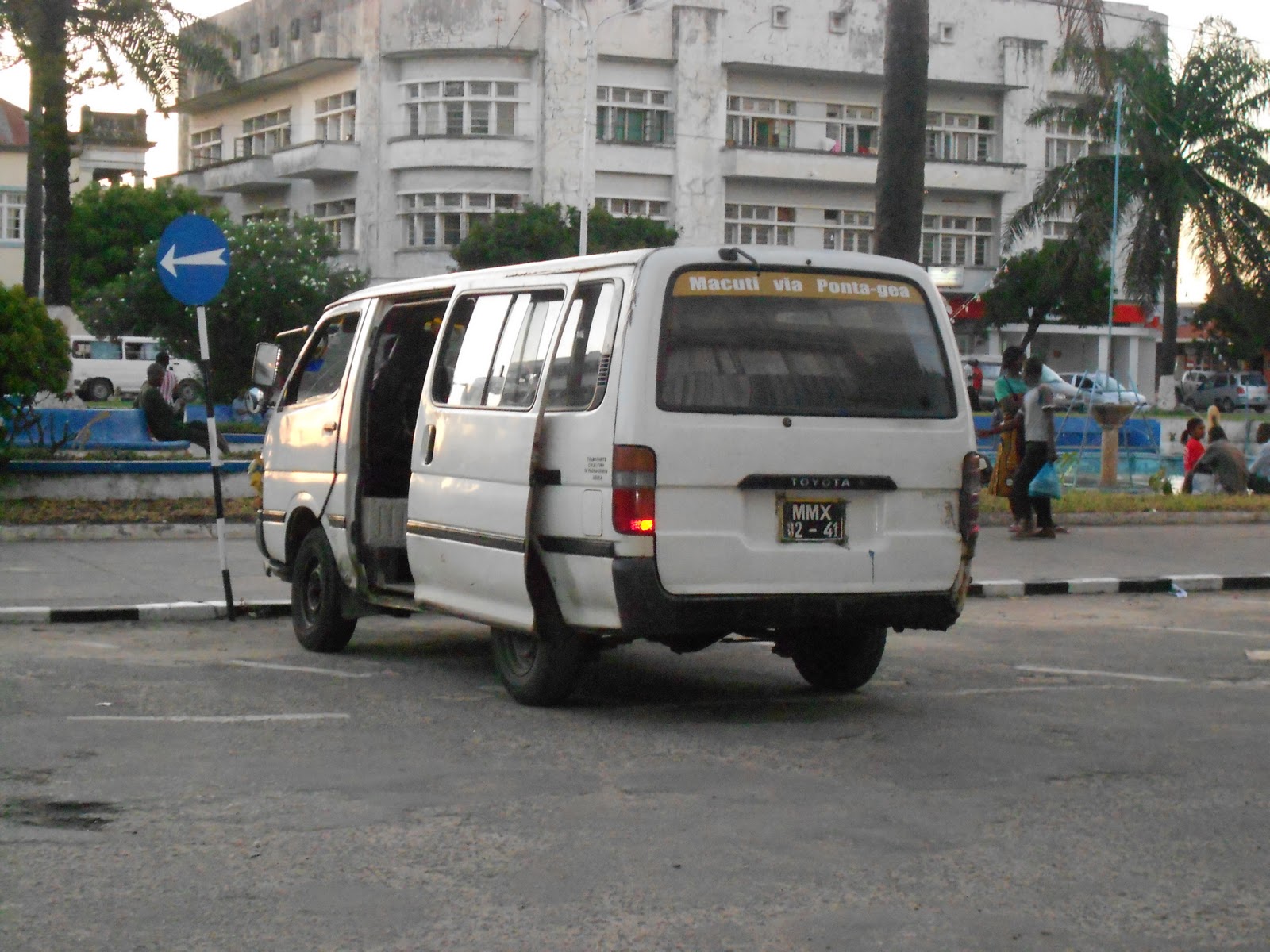
I thought I would write this, since some of you have been asking whether I got a scooter yet. They’re rather inexpensive, but mostly imported and rather cheaply made. My friend Jabulani helped me look into it, but unfortunately the best stores only have full-fledged motorcycles, no scooters. I have been deterred by reasoning 1) likely to break down quickly since even the one I tried at the store (unused) had a broken battery they had to replace before I could even test drive 2) car vs moto (moto loses!) 3) it’s the rainy (monsoon!) season here 4) I’ve become comfortable with local transport…

Welcome to chapas. They’re vans revamped to drive as many people as they can fit. The US Consulate website says its embassy workers are disallowed from using them because of accidents in Maputo. The joke is that you’re lucky if you walk out with clothes on because of high rates of pick pockets. (Good joke.) They have their various destinations/routes on the front windshield. Estoril-Macuti, for example is my route. One ride to wherever is a flat rate at 5 meticais (~20 cents.)


Today was my second ride (back from work). My first ride was aided by a patient’s mother (seen the week prior) who randomly rode from my house with me, and who told me when to get off. Today I began talking to another woman as we waited for the right chapa. Little did I know as she got off before me, that she paid for me additionally in advance. So much for losing my clothes on the chapa – instead I made a friend. Such a kindness is no small trifle when 5 meticais is how much a loaf of bread costs. Thanks Mozambique, for the kindness of strangers and for unexpected friends.

Monday, January 9, 2012

Little blessing

Today the chief nurse at the clinic was telling me how hungry she was because her church was fasting for the first 10 days of the new year.  I had been to a portuguese-speaking church on Sunday where regulars showed me a 10 day prayer schedule they were doing together so I asked her if it was the same church.  It was indeed the same!  So I told her about how my church URC has set 2012 as a year where all of us are reading through the Bible together and memorizing bible verses weekly.  She asked me to tell her the best that I could... and then we went on to have a wonderful conversation about what it means to be a Christian.  It's great that two worlds so far apart in lifestyle, background, language and geography can sit and talk together and afterwards call each other sisters.

"Se alguém está ligado a Cristo transforma-se numa nova pessoa; as coisas antigas passaram; tudo nele se fez novo!" 2 Cor 5:17

"Therefore, if anyone is in Christ, he is a new creation. The old has passed away; behold, the new has come."

Sunday, January 1, 2012

New Year's in Africa

Rainbows were a significant symbol in the Bible and it reminds me of the covenant Noah had with God after the flood. God promised never again to send a flood to destroy all the creatures of the earth. It still serves as a symbolic promise of a future and a God who keeps His promises - since I saw this the last day of 2011, it was a personal encouragement for the year following, 2012.

The rest of the pictures were taken on NYE at a family's home that invited us for a private family celebration of the the new year.  I didn't realize that fireworks are set here like they are for July 4 in the US.  It was a great way to start the new year, especially as someone opened their family to us.